

- Training
- Events
- Membership
- Get Involved
- Find an Expert
- Resources
- About
- Latest News
- Board & Management
- ACA Annual Reports
- Governance Documents
- Awards
- Life Membership
- ACA Lifetime Members
- YCG Award
- Corrosion Medal
- The Rust Award
- The Golden Trowel Award
- The Brian Cherry Awards Forum
- Les Boulton Case Study Award
- The David Whitby Best Review Paper Award
- The Aude Sapere Award
- The Arthur C Kennett Award
- The Marshall Fordham Research Paper Award
- The Victor Nightingall Award
- Kindred Organisations
- FAQs
- Contact
Question
“Are there specific merits of powder coating vs wet applied paint for protecting metals?“
Answer
The main benefit of powder coating (PC) is that there is no release to the atmosphere of solvents found in most industrial coatings, many of which contain hazardous air pollutants (HAP) and or volatile organic compounds (VOC). As the name suggest, PC are applied as a dry powder via a fluidised bed or electrostatic spray, and then melted and cured by heat or UV light on the prepared substrate surface.
Further benefits of PC are that less material is wasted from overspray and that there is more even and complete coverage on complex shapes. As with wet applied coatings there are many different generic types of PC available to suit the intended substrate, environment, appearance, toughness and UV resistance. These include polyesters, epoxies, epoxy-polyester hybrids, urethanes, fluoropolymers and even zinc pigmented primers.
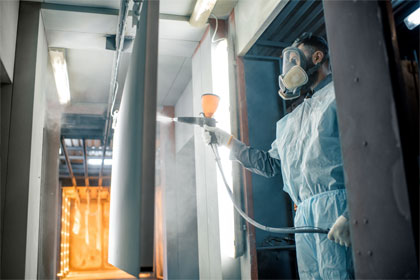
The photo shows application of powder coating by electrostatic spray before curing in an oven pictured in the background.
Thanks to Willie Mandeno for his answer originally submitted in the NZ October Branch Newsletter.